Weixin Service

 DouYin
 KuaiShou





Computing power sinks to desktop: AI office ecosystem iteration may reshape the pattern of the electronic components industry
Date:2026-08-14 15:28:00 Views:1432
Recently, Alibaba Qianwen Office, Tencent WorkBuddy, ByteDance, and Doubao have been continuously integrating and iterating. AI office is gradually getting rid of the single dependence on cloud computing power, and the collaborative operation of computing power on desktop and cloud edge may become the mainstream trend in the industry. At present, top manufacturers are showing a clear differentiation development path: ByteDance focuses on the local operation capability of offline large models on the desktop, Tencent retains the cloud inference core while supplemented by lightweight desktop interaction experience, and Alibaba Qianwen Office focuses on cloud edge collaboration architecture. These three technological routes are developing in parallel, bringing potential structural changes to the electronic components industry from multiple dimensions such as demand structure, product iteration, supply chain pattern, and localization process.
The migration of AI office to the end side is opening up new incremental space for the electronic components industry. The offline operation of local AI intelligent agents may gradually increase the performance requirements of terminal devices for computing power, storage, and power supply stability. The market demand for end side NPUs, high-performance SoCs, high bandwidth memory, and large capacity flash memory may continue to release, while the market space for traditional general-purpose office chips and low-speed storage materials may face contraction. At the same time, AI office equipment has significantly increased its performance requirements for passive components under high-frequency and high current operating conditions, and the demand for high-end passive components such as high-voltage low ESR MLCC, power inductors, and high-frequency magnetic beads has risen. The popularity of multimodal office scenarios has further boosted the market demand for external components such as audio ICs, image sensors, and small connectors. With the trend of continuous expansion of cloud computing infrastructure, optical modules, high-speed connectors, and server specific components may continue to be in short supply, and the electronic components industry is ushering in a development window that benefits both the cloud and the end side.
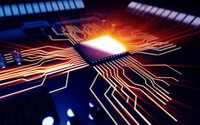
 (2)_20260814152722_485.jpg "摄图网_400264571_人工智能未来办公(企业商用) (2).jpg")
The transition of AI office from cloud to desktop is driving the deepening of structural differentiation in the electronic components market, reshaping the industry's capacity allocation and distribution stocking logic. High end chips, specialized passive components, high-speed connectors, and other products that are suitable for AI computing scenarios have shown a trend of extended delivery times and stable upward prices; The low-end components that come with traditional office equipment are facing continuous pressure from weak demand and inventory depletion. In this context, the original factory is gradually adjusting its production capacity structure, moderately reducing low-end general production capacity, and intensifying the research and mass production of specialized components for AI terminals and computing servers. Distributors can also adjust their stocking strategies synchronously, balancing the allocation of cloud computing materials and end-to-end AI office materials to adapt to the new industry demand structure.
The large-scale popularization of desktop AI office is creating a broader window of substitution for domestic components. Driven by the dual policies of digitalization and localization substitution in government and enterprises, coupled with the rapid iteration of desktop AI hardware and outstanding demand for cost-effectiveness, domestic end side computing chips, power management chips, mid to high end passive components and other products are expected to gradually adapt to local office scenarios such as Qianwen Office and Doubao, and gradually enter the government and enterprise AI PC supply chain. At the same time, the introduction and implementation of domestic high-speed connectors, high-end PCBs, and optical module supporting components in the head of the Internet computing infrastructure are also continuing, and the localization penetration and industry voice are steadily improving.
In terms of hardware research and procurement, the upgrade of AI office scenarios may drive continuous iteration of component selection standards, forming a hierarchical procurement trend. The differentiated office architecture of cloud, end side, and cloud edge collaboration among different manufacturers may force hardware R&D to optimize BOM selection schemes and adapt components of different performance levels according to the scenario. The procurement needs of enterprises are also expected to gradually differentiate. Large enterprises may continue to increase their cloud computing power and layout of end-to-end AI terminals, driving the growth of demand for all categories of components. Small and medium-sized enterprises may prefer lightweight AI office solutions, and the procurement needs for cost-effective domestic substitute materials may have the potential for sustained release.
In the medium to long term, cloud edge collaboration is likely to become the direction of AI office standardization development. Component manufacturers may gradually adjust their product layout, synchronously laying out the two major tracks of terminals and servers. Industry competition may further intensify, and products are expected to continue iterating towards integration and low power consumption. Meanwhile, AI office tools may empower the electronic components industry in reverse, with the potential to improve digital operational efficiency in areas such as BOM matching, inventory forecasting, and demand analysis. Overall, there are still potential challenges in the industry, such as difficulty in quickly matching the rapidly growing market demand for end side specialized components production capacity, tight delivery times for high-end materials or continued increase in hardware upgrade costs for small and medium-sized enterprises, cross scenario capacity crowding, and long domestic chip adaptation and debugging cycles, which may temporarily affect the pace of industry development.
Overall, the sinking of AI office computing power towards the desktop is not a replacement for the cloud market, but rather the opening of a new growth cycle for cloud collaboration. The continuous iteration of the three major AI office ecosystems is constantly expanding the incremental space of computing power chips, storage devices, passive components, and optical communication element devices, promoting the upgrading of industry product structure and the acceleration of localization process. For component manufacturers, distributors and purchasing enterprises, it will be an important direction to seize a new round of industry development dividends and realize transformation and upgrading to continuously follow the iterative trend of AI office hardware and adjust the capacity and inventory layout in advance.