Weixin Service

 DouYin
 KuaiShou





AMD buys AI's' physical world 'for 55 billion
Date:2026-10-16 09:41:08 Views:2
Recently, chip giant AMD officially announced that it has reached a final agreement to acquire AI startup World Labs in a $8.2 billion (approximately RMB 55 billion) all stock transaction. This is AMD's second largest acquisition in history, second only to the previous $50 billion acquisition of Xilinx. The transaction is expected to be completed and delivered by the end of 2026, pending approval from anti-monopoly regulatory agencies in multiple global locations and meeting the standard delivery conditions. After the completion of the transaction, Li Feifei, founder of World Labs, will join AMD as Executive Vice President and Chief Scientist, reporting directly to AMD Chairman and CEO Su Zifeng, and leading the original team to continue to deepen the research and development of space intelligence and physical world models.
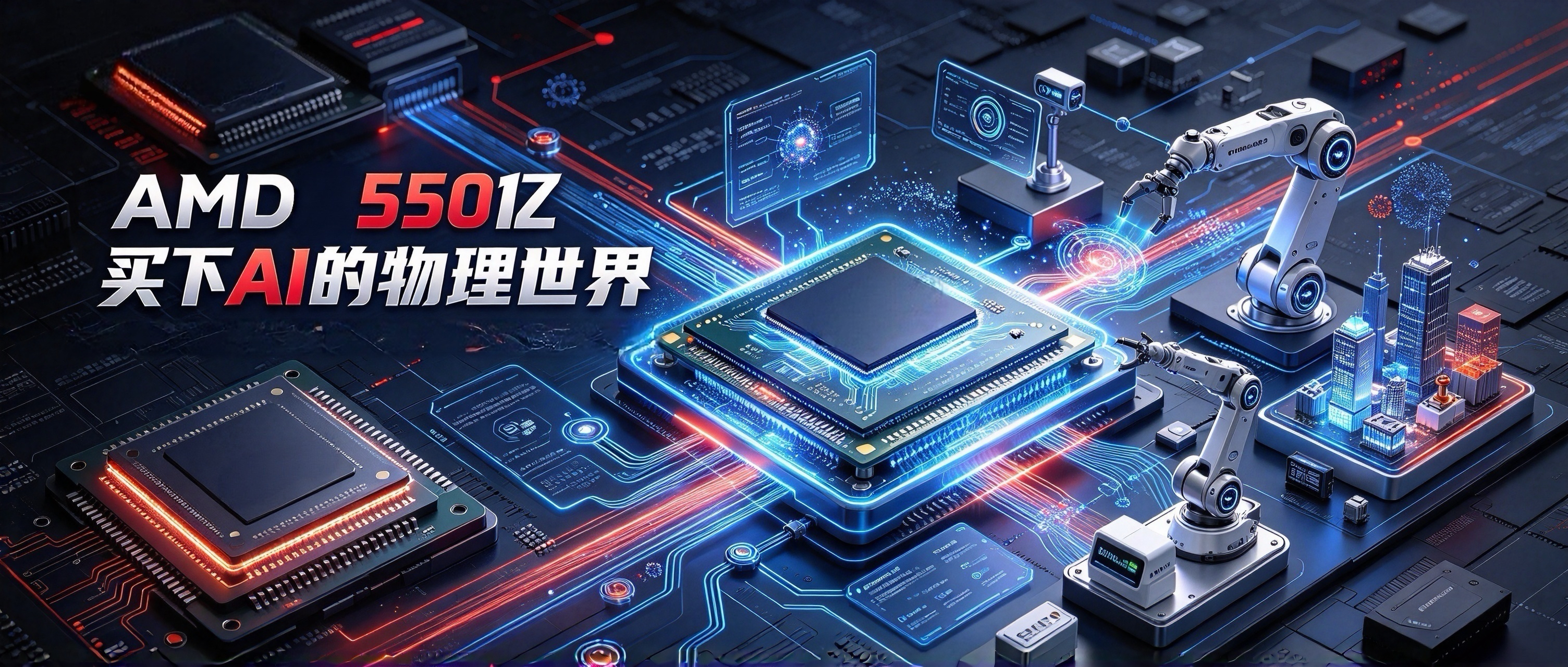
World Labs was founded in early 2024 by renowned AI scholar Li Feifei and core technology inventors such as NeRF. With a team size of only a few dozen people, it is a cutting-edge AI company focused on space intelligence and physical world models. Most of the core members come from top laboratories such as Stanford and Google DeepMind, and have accumulated profound knowledge in the fields of 3D reconstruction, multimodal perception, and physical simulation. The company is committed to creating a world model that can perceive, generate, and understand the three-dimensional physical world, breaking down the technological barriers of AI from understanding text images to recognizing real space and physical rules. Its flagship product Marble can generate roaming, editable, and high fidelity 3D virtual scenes based on multimodal inputs such as text, images, and videos. It supports exporting in mainstream formats such as Gaussian splash and triangular mesh, and opens the World API for robot simulation AR/VR、 The provision of underlying capabilities in scenarios such as digital twins, industrial design, and autonomous driving simulation is one of the most representative solutions that are currently receiving attention in the field of physical AI.
From an industry logic perspective, this acquisition is a key layout for AMD to fill the gap in AI software and hardware collaboration. The current focus of AI competition is gradually shifting from general language models to next-generation directions such as physical world modeling, spatial perception, and robot simulation. In the past two years, AMD has continued to expand in the cloud based large model training market with the MI series AI GPU, but its product positioning is still mainly as a computing hardware supplier, with significant gaps in native world models, 3D space generation, and physical simulation software stacks. After acquiring World Labs, AMD can deeply bind the spatial world model with its own AI chips, creating an integrated solution of "hardware+spatial model", providing end-to-end computing power and model combinations for scenarios such as robots, digital twins, and metaverse, breaking away from the role positioning of simply selling chips and competing head-on with industry competitors in the physical AI field. It is worth mentioning that AMD Ventures has already participated in World Labs' Series B investment, and the two parties have had a long-term technology cooperation. This acquisition is a continuation of the strategic investment towards comprehensive integration.
From the perspective of industrial value, this acquisition also confirms the capital and industrial value of the world model track. World Labs has not been established for a long time, and with its space intelligence technology, it has achieved a valuation of billions, reflecting industry consensus: in the future, AI cannot just stay in text conversations, but also needs to understand three-dimensional space, predict object interactions and physical results, in order to truly land in physical scenes such as humanoid robots and industrial automation. Major tech giants are laying out physical world models, but AMD has chosen to directly acquire mature teams, saving the time and cost of building model teams from scratch and quickly filling in software and algorithm capabilities.
However, there are also many differences and challenges in the market. On the one hand, adopting an all stock trading format means that AMD will dilute its existing shareholder equity, and World Labs has not yet achieved large-scale commercialization. The high consideration is essentially a prediction of the growth potential of the future space intelligence market; On the other hand, the space world model itself requires extremely high computing power. How to efficiently adapt models such as Marble to AMD chip architecture, continuously reduce training and inference costs, and achieve commercial implementation is the core challenge that the team needs to overcome in the subsequent integration stage. There is still uncertainty as to whether the transaction can be completed as scheduled by the end of 2026, given the increasingly stringent anti-monopoly regulatory scrutiny worldwide.
Looking at the global AI industry, chip manufacturers' acquisition of cutting-edge AI model teams has become a normalized strategy. Unlike general language models, World Labs focuses on physical world models that are closer to the needs of physical industries, and are expected to reshape the development paradigm of industrial simulation and robot training. Su Zifeng and Li Feifei, two Chinese research managers, have joined forces to promote AMD's transformation from an AI computing power supplier to a full stack AI manufacturer with native spatial modeling capabilities. This also marks a new stage in the global competition between chips and AI, which has officially entered a new stage of "computing power+spatial world model".