Weixin Service


 DouYin

 KuaiShou







Base station becomes computing power node: Nvidia attacks telecom operators, Shenzhen enterprise launches 6G computing power base station
Date:2026-11-05 16:55:53 Views:10
On October 21st, Nvidia announced that major global telecom operators are expanding their accelerated computing technology to communication networks. T-Mobile has completed the world's first commercial network AI-RAN call, while Deutsche Telekom, British Telecom, and Elisa from Finland have simultaneously launched AI-RAN pilots. On the same day in Shenzhen, Tongyu Communication and Jiaxian Communication announced a strategic cooperation, with the latter releasing 6G integrated AI-RAN base stations and 6G edge AI agents that support local AI agent deployment. On one hand, AI chip giants are bringing computing power into communication networks with global operators, while on the other hand, China's communication industry chain is entering the early stage of industry implementation from the base station machine end upwards. The two paths converge at "AI-RAN", marking the formal entry of this concept, which was previously stuck in the technical white paper, into the early stage of industry implementation.
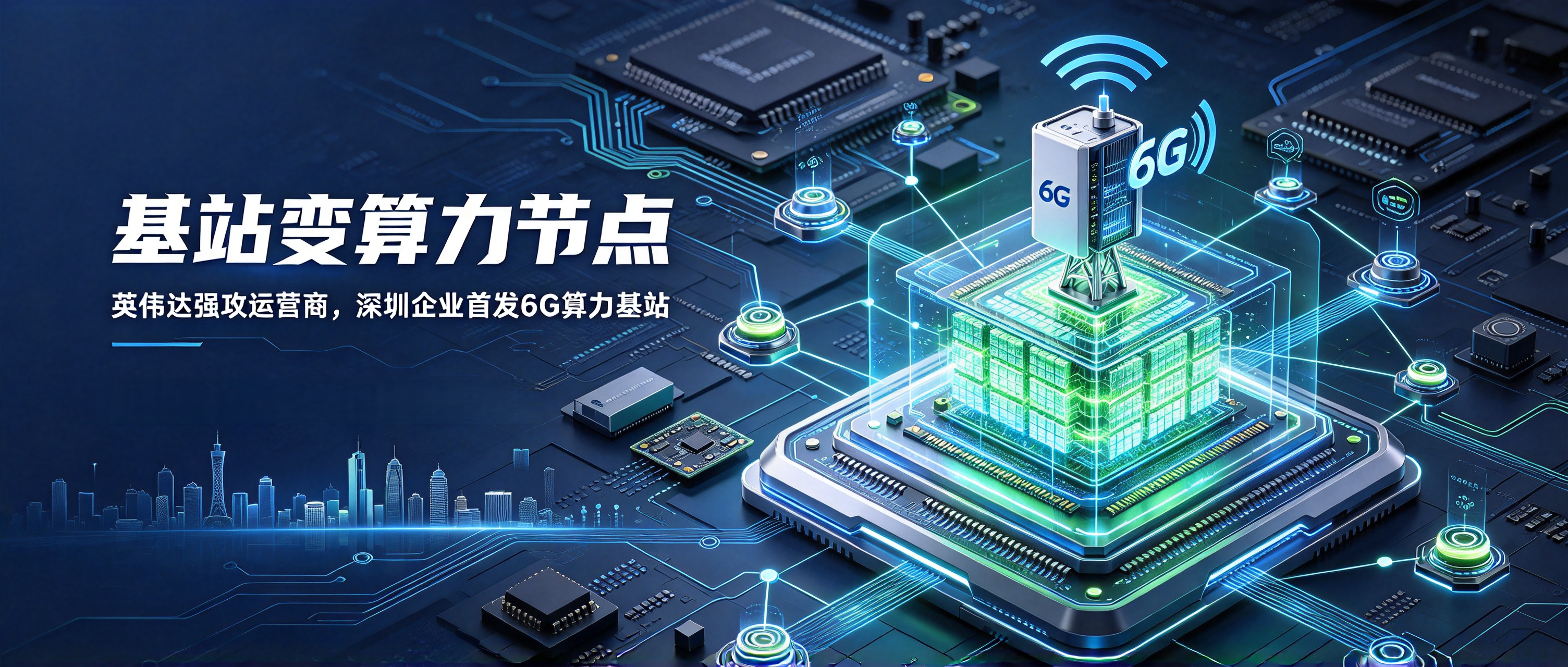
Huang Renxun proposed at GTC that in the future, the core services of operators will add AI computing power supply, and base stations will become the basic nodes of distributed physical AI networks. The logic is that base stations rely on wireless sensing and beamforming capabilities to complete low latency AI inference nearby, adapting to intelligent scenarios of real-time interaction in the physical world. This is precisely why NVIDIA is fully committed to the operator ecosystem.
To understand the essence of this round of competition, we need to first return to AI-RAN itself. Traditional base stations are only responsible for signal transmission and reception, while AI-RAN introduces GPU level accelerated computing capabilities in wireless access networks, allowing base stations and adjacent edge nodes to complete AI inference nearby while transmitting communication signals. It does not pursue the complete integration of large models into base stations, but rather sinks tasks that are extremely sensitive to latency and must respond in milliseconds on-site to the network edge, such as real-time control of industrial robots, obstacle avoidance decisions for low altitude aircraft, and tuning of autonomous vehicles in the park. The data no longer needs to be transmitted thousands of miles back to the remote cloud center. Processing it nearby not only reduces the bandwidth pressure of transmission, but also pushes the response delay to a level that traditional cloud architectures cannot achieve.
The actions in Shenzhen happen to follow the same train of thought. In August of this year, Tongyu Communication announced plans to acquire approximately 25% equity of Jiaxian Communication for 300 million yuan, extending its business from communication antennas and microwave communication to base station equipment, edge computing power, and AI-RAN devices. The three types of products released by Jiaxian Communication on the same day correspond to distributed computing power on the base station side, integrated AI-RAN devices, and terminal edge intelligence. Among them, the 6G integrated base station that supports local AI agent deployment is the most popular - it means that the base station can directly run small AI models locally and provide inference services for surrounding devices. The function of these devices is to sink latency sensitive tasks to the network edge for nearby inference, thus forming a collaborative division of labor of "cloud edge end": the cloud is responsible for large model training, the terminal is responsible for perception and execution, and the edge base station is responsible for nearby inference and real-time control.
The simultaneous outbreak of two events carries the transformation of multiple industries behind them. The computing power architecture is spreading from centralized large data centers to distributed systems that collaborate with cloud, edge, and base stations. Operators have scarce resources such as site locations, spectrum, and fiber optics, making them the natural carriers of edge computing power. Whoever holds the hardware, protocol, and business definition rights of base station computing power can gain the standard discourse power of the next generation infrastructure. Nvidia is penetrating downwards, aiming to move beyond its position as a pure chip supplier and instead rely on the CUDA ecosystem to bind with operator channels, locking in long-term incremental computing hardware. At the same time, the underlying paradigm of mobile communication is also being restructured: the main focus of the evolution from 5G to 6G in the past was on bandwidth and speed, while AI-RAN is opening up new directions. The network is no longer just a transmission pipeline, but also has perception and computing properties. The entire communication software and hardware system needs to be restructured for AI native. Overseas companies are taking the path of chip compatibility for communication, while domestic manufacturers are integrating computing power from communication equipment. These two technological paths will continue to compete at the standard and interface levels. This track also accurately meets the needs of high real-time scenarios such as physical intelligence, low altitude economy, and industrial Internet, and fills the computing gap between the cloud and the terminal, which is also the foundation of the predicted market space of $200 billion for AI-RAN in 2030. From a more macro perspective, this is still an early global industry chain bottleneck: overseas camps are building closed software and hardware stacks with chip giants, equipment manufacturers, and operators, while domestic manufacturers rely on RF and base station supply chains to land prototypes first, aiming to compete for independent solution seats in the 6G and AI-RAN standard development stage.
Overall, the real focus of this round of competition is not on who builds the first 6G base station, but on who can block the "end-to-end computing power entrance". NVIDIA extends downwards from the chip side, while Chinese communication equipment manufacturers break through upwards from the base station side. The two routes eventually intersect at the same node, which is likely to be the winner of the digital infrastructure competition in the next decade.