Weixin Service


 DouYin

 KuaiShou







OpenAI launches GPT-6.1 Terra: Half price mid-range model with focus on drawing analysis and computer control
Date:2026-11-16 15:41:12 Views:33
Recently, OpenAI officially launched the GPT-6.1 Terra, as the mid-range main model of the GPT-6 series. The model focuses on efficient visual understanding and computer use, with the ability to directly analyze technical drawings, complete video editing, and execute office processes across software. It is designed for high-frequency automation, engineering, and creative work scenarios in enterprises, further reducing the cost of intelligent agent implementation.
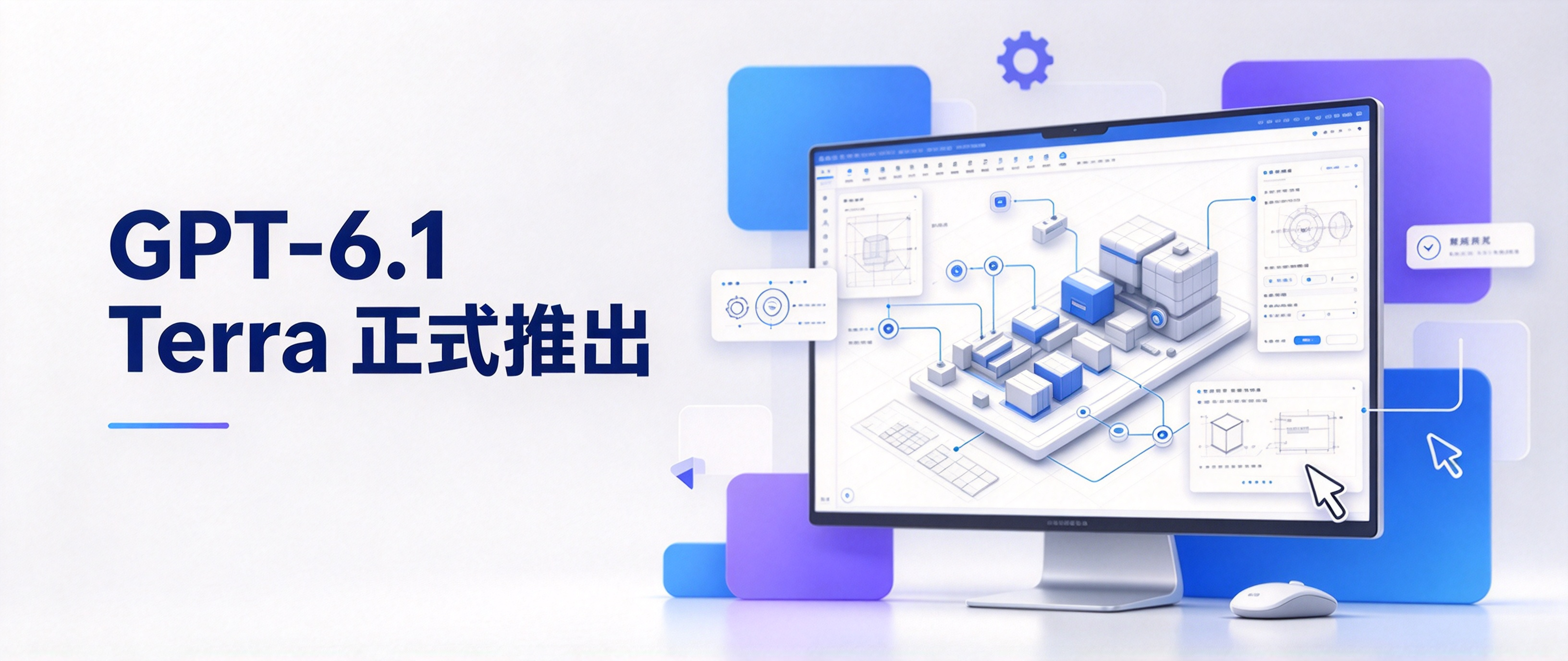
Unlike flagship models that lean towards extreme deep reasoning, the core idea of GPT-6.1 Terra is to balance speed, capability, and cost. It inherits and upgrades the computer operation capabilities of the previous generation GPT-5.6 Terra, capable of recognizing screen interface information, autonomously switching software, completing routine tasks such as form input and document writing; Significant breakthroughs have also been achieved in professional visual tasks, supporting the understanding of architectural and mechanical engineering drawings and the extraction of size and annotation information. It can also undertake creative production tasks such as video editing, lens verification, and time code material organization, bridging the link from drawing analysis to audio and video content processing.
In the official benchmark test Agents' Last Exam, under moderate inference configuration, GPT-6.1 Terra scores 15 percentage points higher than GPT-5.6 Terra, and the single task cost is only one-third of the previous generation; The typical task execution speed is about three times that of GPT-6 Astra and GPT-6.1 Sol, with comprehensive capabilities comparable to GPT-6 Astra. However, the unit token price is only about one tenth of the latter, highlighting the cost-effectiveness advantage. At the same time, the accuracy of the model facts has been optimized, and the fact error rate in low inference mode has decreased from 53.6% of the previous generation to 16.7%. The illusion problem has been significantly improved, making it more suitable for scenarios such as engineering drawings and bill entry that require high information reliability.
The pricing strategy is a major highlight of this update. The GPT-6.1 Terra standard API price has been reduced by 50% compared to GPT-5.6 Terra and GPT-6.1 Sol, further reducing cache input costs. It is suitable for developers to build large-scale automated agent businesses, such as batch parsing of drawings, document recognition, and normalized video material processing. This model has now been integrated into ChatGPT Work and Codex, and can be directly called by enterprises and developers to support high concurrency and repetitive professional workflows at lower costs.
The significant decrease in the threshold for model calling will also be transmitted from the demand side to the electronic components and semiconductor industry chain, bringing about structural changes. Terra is designed for high concurrency multimodal inference scenarios such as drawing analysis and video frame processing, which will give rise to a large number of lightweight and long-term online intelligent agent task clusters. This differs from the demand characteristics of traditional large model training clusters: the training end pursues the maximum computing power of a single card, while such agent inference clusters value low latency, high throughput, stable and continuous concurrent scheduling, driving the synchronous uplink of server CPU, high-speed interconnection, HBM, CPO encapsulated optical links, and expanding the usage of internal high-speed interfaces, signal chain simulation devices, high-precision ADCs, high-speed connectors, high-voltage MLCC, power inductors and other components. At the same time, engineering drawing recognition itself belongs to industrial scenarios, and when this type of AI capability sinks to the device end, industrial vision boards FPGA、 The storage, power management chips, and sensing signal conditioning components that come with edge NPUs will also usher in new application scenarios. From an industrial logic perspective, the mass production of inclusive agent models such as Terra essentially spreads AI computing power consumption from a few heavy training tasks to the normalized business processes of tens of millions of small and medium-sized enterprises. The demand for computing power shifts from "pulse like explosion" to "sustained and distributed growth", which benefits the stable shipment of full chain components and forces component suppliers to adapt to the new standards of AI inference servers and industrial vision terminals in terms of specification consistency, batch delivery, and power optimization.
From an industry perspective, GPT-6.1 Terra represents the acceleration of big models from "dialogue and question answering tools" to digital work agents that can directly manipulate software. In the past, drawing recognition and video editing mostly required professional software and manual cooperation. Nowadays, models rely on integrated visual reasoning and computer operation capabilities to connect multiple discrete processes. For manufacturing, architectural design, and new media content teams, this means that the automation threshold for basic repetitive professional work continues to decrease. However, the industry also points out that the model is positioned in the mid-range, and flagship models are still needed to support complex deep research, high-precision simulation, and ultra complex film and television post production scenarios. The greater value of Terra lies in its scalability and inclusiveness: allowing a large number of small and medium-sized enterprises and development teams to implement AI automation processes with drawing parsing and video processing capabilities without having to bear the high cost of calling flagship models.
With the landing of Terra, OpenAI's GPT-6 product lineup is more clearly divided: Astra targets top-level complex tasks, Sol takes into account code intelligent agents, Terra focuses on high cost-effective high-frequency office automation, forming a layered supply, and continuously promoting the popularization and landing of operable AI intelligent agents in the industry.